24-hour Emergence Response Technician


Prerequisite: Emergency Response Operation
Class Hours: 24
Regulation(s): 29CFR 1910.120 (q)(6)(iii)
Course Code: ERT


Jump To Section
Regulation | Open Enrollment Seminars | Other Course Options | Individual Products

Open Enrollment Seminars

$395.00 Enroll Now

24-HR ER Technician Seminar - Cleveland, OH on Jul 16-18, 2013

Richfield (Cleveland), Ohio Location & Directions

Location Image

Days Inn & Suites Richfield

4742 Brecksville Road
Richfield, Ohio 44286

Phone: 330.659.6151

Fax: 330.659.3819

Mention New Environment, Inc. To Receive A Special Room Rate of $ 79.00 + tax per night.

$79.00 rate includes the following:
Free upgrade to king junior suite with microwave and refrigerator.
In order to guarantee the special New Environment rate, amenities, and availability you MUST call the hotel directly at 330.659.6151.


Click Here For More Detailed Hotel Information
This will take you to the Hotels website
(Will open in a new window)
Get Driving Directions
Map logo
(Will open in a new window)

$395.00 Enroll Now

24-HR ER Technician Seminar - Cleveland, OH on Nov 5 - 7, 2013

Richfield (Cleveland), Ohio Location & Directions

Location Image

Days Inn & Suites Richfield

4742 Brecksville Road
Richfield, Ohio 44286

Phone: 330.659.6151

Fax: 330.659.3819

Mention New Environment, Inc. To Receive A Special Room Rate of $ 79.00 + tax per night.

$79.00 rate includes the following:
Free upgrade to king junior suite with microwave and refrigerator.
In order to guarantee the special New Environment rate, amenities, and availability you MUST call the hotel directly at 330.659.6151.


Click Here For More Detailed Hotel Information
This will take you to the Hotels website
(Will open in a new window)
Get Driving Directions
Map logo
(Will open in a new window)

Course Regulation

29 CFR 1910.120:
  • (q)(6): Training. Training shall be based on the duties and function to be performed by each responder of an emergency response organization. The skill and knowledge levels required for all new responders, those hired after the effective date of this standard, shall be conveyed to them through training before they are permitted to take part in actual emergency operations on an incident. Employees who participate, or are expected to participate, in emergency response, shall be given training in accordance with the following paragraphs:
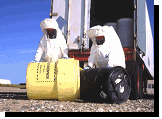
  • (q)(6)(iii): Hazardous materials technician. Hazardous materials technicians are individuals who respond to releases or potential releases for the purpose of stopping the release. They assume a more aggressive role than a first responder at the operations level in that they will approach the point of release in order to plug, patch or otherwise stop the release of a hazardous substance. Hazardous materials technicians shall have received at least 24 hours of training equal to the first responder operations level and in addition have competency in the following areas and the employer shall so certify.:
    1. Know how to implement the employer’s emergency response plan;
    2. Know the classification, identification and verification of known and unknown materials by using field survey instruments and equipment;
    3. Be able to function within an assigned role in the Incident Command System;
    4. Know how to select and use proper specialized chemical personal protective equipment provided to the hazardous materials technician;
    5. Understand hazard and risk assessment techniques;
    6. Be able to perform advance control, containment, and/or confinement operations within the capabilities of the resources and personal protective equipment available with the unit;
    7. Understand and implement decontamination procedures;
    8. Understand termination procedures;
    9. Understand basic chemical and toxicological terminology and behavior.
  • It is also a prerequisite to the 8-Hour On-Scene Incident Commander Program.

The Following Topics are Covered by this Course

  • History Of The Law
  • Regulatory Overview
  • Poisons
  • Chemical Exposure
  • Hazard Assessment
  • Fires And Explosions
  • Reference Material
  • Oxidizers
  • Oxygen Deficiency
  • Ionizing Radiation
  • Potential Site Hazards
  • Heat Stress
  • Cold Exposure
  • Noise Exposure
  • OSHA 1910.146
  • Planning And Organizing
  • ERGB Exercise
  • Training
  • Medical Surveillance
  • Site Characterization
  • Air Monitoring
  • Self-Contained Breathing Apparatus
  • Supplies-Air Respirators
  • Air-Purifying Respirators
  • Fit Test Procedures
  • Chemical Protective Clothing
  • Site Control
  • Decontamination Techniques
  • Drums & Containers
  • Site Emergencies
  • Haz. Material Terminology
  • Review And Final Test
Fully Protection Suit
Level A Suit Level B Suit
Commander Photo

Other Course Options

On-Site Training

New Environment, Inc. offers On-Site Training for this course, call or E-mail us to schedule this course.

Individual Products

Instructor Materials

$395.00 Add to Cart

24-Hour Emergency Response Technician - B Lesson Plan

The Following Topics are Covered in this Course

  • History Of The Law
  • Regulatory Overview
  • Poisons
  • Chemical Exposure
  • Hazard Assessment
  • Fires And Explosions
  • Reference Material
  • Oxidizers
  • Oxygen Deficiency
  • Ionizing Radiation
  • Potential Site Hazards
  • Heat Stress
  • Cold Exposure
  • Noise Exposure
  • OSHA 1910.146
  • Planning And Organizing
  • ERGB Exercise
  • Training
  • Medical Surveillance
  • Site Characterization
  • Air Monitoring
  • Self-Contained Breathing Apparatus
  • Supplies-Air Respirators
  • Air-Purifying Respirators
  • Fit Test Procedures
  • Chemical Protective Clothing
  • Site Control
  • Decontamination Techniques
  • Drums & Containers
  • Site Emergencies
  • Haz. Material Terminology
  • Review And Final Test


$300.00 Add to Cart

ER Technician Version B PowerPoint CD


$1,590.00 Add to Cart

40-hr. Hazardous Waste Worker / 24-hr. Emergency Response Technician DVD Package

These are professionally produced video programs. The average run time is 12.17 minutes per topic, about 3.75 Hours of material. These videos are designed to be used with our "HAZWOPER Lesson Plans".


Click on the each dvd for a description of the titles.

This Package consists of 17 video titles on 3 DVD's.

Click Here For A Description Of DVD 1 DVD 1 - 40-hr. Hazardous Waste Worker / 24-hr. Emergency Response Techniction

Video 1: Introduction to Industrial Toxicology (15 min.)

What is toxicology? Terms, definitions, and entranceways of toxins into the body are covered in this extensive video. The different types of hazards, hazard identification, and exposure limits are explored, including the different types of TLV. Basic emergency response procedures are outlined as well as how to use Emergency Response Guidebooks to identify and properly respond to chemical hazards.
 
Video 2: NFPA Hazardous Materials Labeling/I.D. (7 min.)

NFPA labeling and ID program defined and stresses the importance of understanding these signs and placards. Firefighters have used this program for their training.
 
Video 3: Carbon Monoxide Poisioning (13 min.)

Defines carbon monoxide poisoning and how to reduce the effects of this health hazard. Almost every industry is exposed, but very little attention is given to its effects. Excellent awareness program.
 
Video 4: Hazardous Energy Source-Lockout/Tagout (10 min.)

Mandatory training for both "affected" and "authorized" personnel. Explains what lockout-tagout is and how to control potential accidents from machines and equipment that may be started accidentally through a variety of energy sources.
 
Video 5: Trenching and Shoring Operations (12 min.)

Meets training requirements for those persons assigned the job of trenching and shoring. Explains the safety rules, requirements, procedures and emergency procedures.

Click Here For A Description Of DVD 2 DVD 2 - 40-hr. Hazardous Waste Worker / 24-hr. Emergency Response Technician

Video 1: Heat Stress (9 min.)

Program explains how to protect your body in high temperature/high humidity environments. Explains precautions to avoid heat stroke, heat exhaustion, and basic first aid procedures.
 
Video 2: Confined Space Entry (11 min.)

Meets training requirements for anyone working or entering a confined space. Explains the rules, procedures, emergency procedures and more.
 
Video 3: Confined Space Entry: The Silent Killers (18 min.)

This training program provides an overview of the general types of hazards associated with confined spaces, basic atmospheric testing requirements and information relating to confined spaces. The major emphasis for this program is the ATTENDANT. Generally, this person is the least trained, yet has the life and death responsibility for those entering the confined space. This program helps the attendant understand his/her responsibilities. Attendant training is one of the most important "confined space" training programs you can use.
 
Video 4: Job Safety Analysis (11 min.)

Program explains what job safety analysis is all about and how to conduct a job safety analysis.
 
Video 5: Testing & Monitoring for Hazardous Gases (12 min.)

General awareness and basic safety for persons who must test and monitor for hazardous gases in such areas as trenching operations, confined space entry, and others.
 
Video 6: Life Saving Through Air Monitoring (13 min.)

A survey of common toxic atmosphere hazards including oxygen deficiency, hydrogen sulfide, carbon monoxide/dioxide. Also covered are general examples of air monitoring techniques, sampling, calibration, and how to deal with combustible/toxic gases.

Click Here For A Description Of DVD 3 DVD 3 - 40-hr. Hazardous Waste Worker / 24-hr. Emergency Response Technician

Video 1: Respirators & How to Use Them (10 min.)

Program explains the different types of respirators, how they are used, some of their capabilities and limitations. An excellent training rogram in the use of respiratory protection equipment for employees.
 
Video 2: How to Fit Test Respirators (10 min.)

This training video explains why fit testing is necessary, how to properly fit test respiratory equipment, and general information on caring and using equipment.
 
Video 3: Chemical Protective Clothing (10 min.)

Designed to explain various types of chemical protective clothing requirements, various limitations of protective clothing and information ating to one of the most important aspects of HAZWOPER training. Reviews potential heat stress related to wearing chemical protective clothing.
 
Video 4: Obtaining Information in an Emergency (17 min.)

If you are the first responder in a hazardous materials emergency, then you need to know where to get HAZWOPER information. This video covers HAZWOPER issues, including: emergency response plans, hazardous materials clean up operations, and emergency procedures. But there is more. Where would you find the information on Facility Emergency Response Plans, SPCC, NFPA 704 System, Emergency Response Guidebook, MSDSs, and Shipping documents? After training with this video, everyone will know.
 
Video 5: Donning/Doffing/Decontamination (17 min.)

Designed to meet training requirements of subject title. Describes how to don chemical protective clothing, how to properly remove it, and decontamination procedures. Includes actual HAZWOPER footage of proper decontamination from real life situations.
 
Video 6: Chemical Spills, Leaks & Clean Up Operations (15 min.)

Meets training requirements for basic spills and clean up procedures. Emphasizes individual safety, proper equipment, and general safety rules relating to spill clean up.


Student Materials

$37.50 Add to Cart

24-Hour Emergency Response Technician - B Student Classroom Material

Student Material Includes:

Student Background Survey
Color Student Classroom Workbook
50 Question Test
NFPA 704 Wallet Card
Certificate Of Completion*
Participant Evaluation Form


$6.00 Add to Cart

DOT Emergency Response Guidebook

This Guidebook is primarily a guide to aid first responders in quickly identifying the specific or generic hazards of the material(s) involved in the incident, and protecting themselves and the general public during the initial response phase of the incident.

The Emergency Response Guidebook is updated every three to four years to accommodate new products and technology.

Use this DOT-issued guidebook to help you satisfy DOT's requirement that Hazmat shipments be accompanied by emergency response information (49 CFR Section 172.600).

2012 Emergency Response Guidebook Summary of Changes from 2008 ERG:
  • General Information (WHITE) pages – several sections have been moved to the back of the book. Various sections have been expanded and/or revised, including:
    • Shipping Documents (Papers)
      How to Use this Guidebook During an Incident
      User’s Guide
      Isolation and Evacuation Distances
      Who to Call for Assistance
      Table of Placards and Initial Response Guide to Use On-Scene
      Rail Car Identification Chart
      Road Trailer Identification Chart
      Fire and Spill Control
      Pipeline Safety Information
      Criminal/Terrorist Use of Chemical/Biological/Radiological Agents
      Glossary
      Publication Data (and related information)
      Emergency Response Telephone Numbers

  • Index List of Dangerous Goods in Order of ID Number (YELLOW-bordered pages) and the Index List of Dangerous Goods in Alphabetical Order (BLUE-bordered pages):
    • Addition of all new dangerous goods listed in UN Recommendations on the Transport of Dangerous Goods to 17th Revised Edition

  • Safety Recommendation/Emergency Response Guides (“Guides,” or ORANGE-bordered pages):
    • Tune-up of some guides

  • Table of Initial Isolation and Protective Action Distances, and the Table of Water-Reactive Materials Which Produce Toxic Gases (GREEN-bordered pages):
    • Added Table 3 for six gases which are toxic by inhalation
      Tune-up of Initial Isolation and Protective Action Distances

  • Added a Boiling Liquid Expanding Vapor Explosion (BLEVE) Chart to Fire and Spill Control Section
  • Added an Improvised Explosive Device (IED) Safe Standoff Distances Chart to Criminal/Terrorist Section

Published by the U.S. Department of Transportation.

$6.00 Add to Cart

Hazardous Material Compliance Pocketbook

This easy-to-read pocketbook gives your drivers fast access to the current regulatory information they need while hauling hazardous materials. And that can help reduce the chances of hazardous materials incidents resulting from human error.

Contains hazardous materials regulations as amended by HM-215G, the information your drivers need to stay in compliance.

Updated monthly, the pocketbook covers identifying hazmat shipments, placarding, loading and unloading, transport, and specific class requirements. Includes the §171.101 Hazardous Materials Table with a placard column to help drivers easily identify DOT-required placards, plus the List of Hazardous Substances, the List of Marine Pollutants, and special provsions.

$15.00 Add to Cart

NIOSH Pocket Guide To Chemical Hazards

The NIOSH Pocket Guide to Chemical Hazards presents key information and data in abbreviated or tabular form for chemicals or substance groupings (e.g. cyanides, fluorides, manganese compounds) commonly found in the work environment. With this handy book you'll find information on recommended exposure limits, permissible exposure limits, chemical and physical properties, health hazards and personal protection for 677 chemicals regulated at the federal level.

The NIOSH Pocket Guide includes the following features:
  • September 2010 Current Printing Date.
  • New layout for the Chemical Listing section, each chemical arranged in its own table.
  • Expanded Chemical, Synonym and Trade Name Index.
  • Conversion factors, Chemical Abstracts Service Registry Number and The Registry of Toxic Effects of Chemical Substances.
  • Updated DOT ID and Guide Numbers to reflect changes made by DOT in the 2004 Emergency Response Guidebook.
  • NIOSH Recommended Exposure Limits (NIOSH RELs).
  • Occupational Safety and Health Administration Permissible Exposure Limits (OSHA PELs).
  • NIOSH Immediate Dangerous to Life and Health values (NIOSH IDLHs).
  • A physical description of the agent with chemical and physical properties.
  • Measurement methods.
  • Personal Protection and Sanitation Recommendations.
  • Particulate respirator recommendations revised to include Part 84.
  • Information on Health Hazards including: Route, Symptoms, First Aid and Target Organ information.
  • Revised Appendix E to include OSHA respirator requirements for hazardous substances identified in the preamble to the OSHA Respiratory Protection Standard (29 CFR 1910.134).